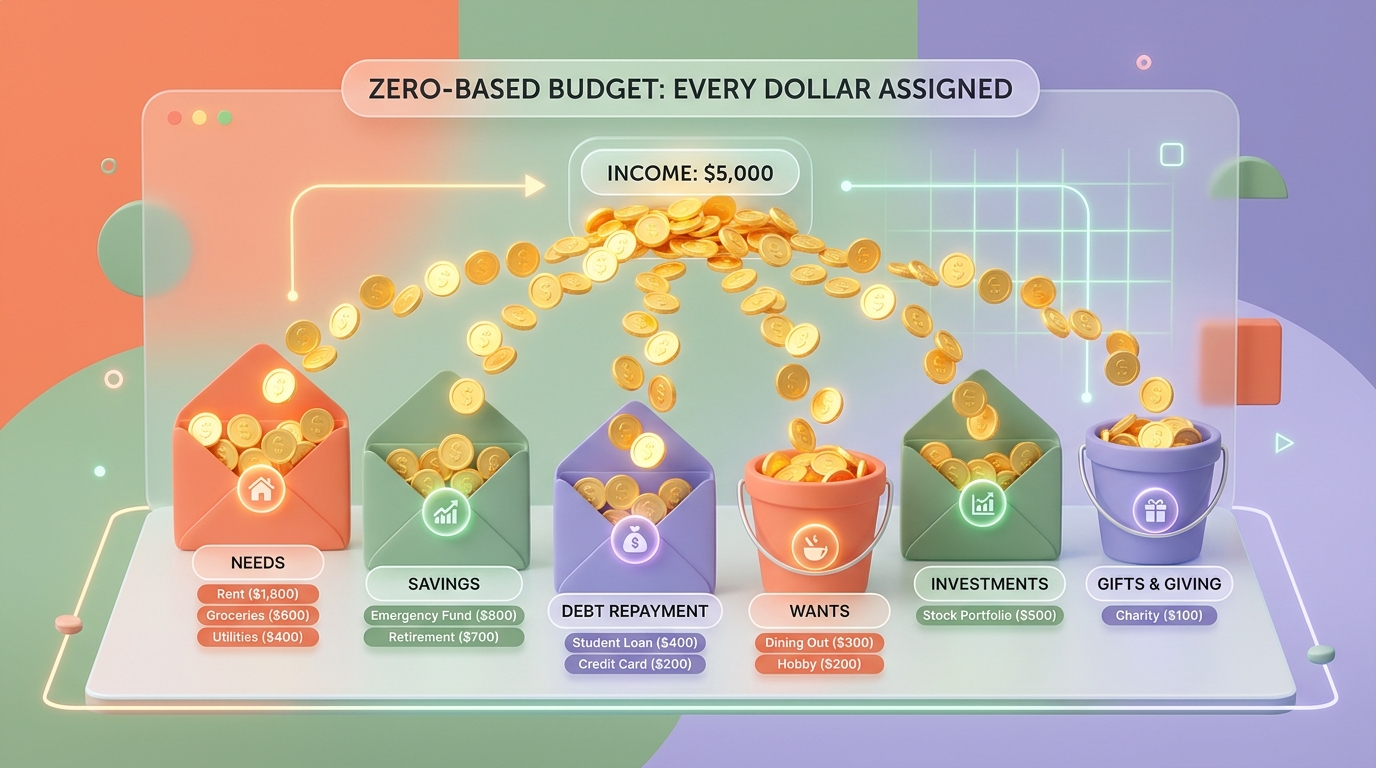
What Is Zero-Based Budgeting?
Zero-based budgeting (ZBB) is a money management method where you assign every single dollar of your income to a specific category — expenses, savings, debt payments — so that income minus allocations equals zero. It sounds intense, but it's one of the most effective ways to stop money from "disappearing."
The core principle: every dollar has a job. Whether that job is paying rent, funding your vacation savings goal, or going toward your emergency fund — no dollar is "floating" unassigned.
💡 Zero-Based Budget Example (Combined income: $5,000/month)
Why Zero-Based Budgeting Works Especially Well for Couples
For couples, ZBB brings an added benefit beyond just tracking money — it forces alignment. You can't assign every dollar without first agreeing on priorities. That means having the "should we spend $400 on dining out or $200?" conversation before the month starts, not after you've already overspent.
- Forces alignment: Both partners must agree on every category allocation
- Removes the mystery: No more "where did $800 go this month?"
- Makes savings intentional: Savings goals become a budget category, not an afterthought
- Reduces arguments: Discretionary spending is pre-agreed, not reactive
- Creates shared financial purpose: Your goals become the reason you're budgeting together
Top Zero-Based Budget Apps for 2026
YNAB is the gold standard for zero-based budgeting. The methodology is sound, the app is powerful, and the community is one of the most active in personal finance. YNAB requires you to "roll with the punches" (adjust your budget mid-month) and think in current dollars, not projections.
✓ Pros
- Best-in-class ZBB implementation
- Excellent reports & age-of-money metric
- Active community & free workshops
- Strong couple mode
✗ Cons
- Expensive at $14.99/month
- Steep learning curve (2-3 weeks)
- Requires bank account linking
- Not couple-specific in design
EveryDollar is Dave Ramsey's zero-based budgeting app, designed to align with his Baby Steps debt-payoff methodology. The free version is fully manual (no bank sync), which makes it more private but more work. Premium adds bank syncing.
✓ Pros
- Free manual version available
- Simple ZBB interface
- Integrates with Ramsey's methodology
- Works for couples
✗ Cons
- Premium is expensive ($17.99/mo)
- Free version lacks automation
- Dated design vs competitors
- Pushes Ramsey products
 Mutual Save & Split — ZBB-Inspired for Couples
Free + $4.99/month · iOS
Mutual Save & Split — ZBB-Inspired for Couples
Free + $4.99/month · iOS
Mutual takes a couples-first approach to ZBB principles. Rather than strict dollar-by-dollar assignment, Mutual Save & Split uses expense categories and shared savings goals to create a ZBB-style structure that's more practical for couples with different spending styles and incomes.
✓ Pros
- Income-based fair splits (unique)
- Real-time sync between partners
- No bank account linking required
- Free plan genuinely useful
- Shared savings goals built-in
✗ Cons
- Less strict ZBB than YNAB
- iOS only currently
- Manual entry (by design, for privacy)
→ See our full couples budgeting app comparison
Goodbudget uses the classic envelope budgeting system — a tactile form of ZBB where you divide money into labeled envelopes at the start of the month. Digital envelopes replace physical ones, and couples can sync on the same account. No bank linking required.
✓ Pros
- No bank linking required
- Couple-friendly sharing
- Works on web too
- Free tier available
✗ Cons
- Dated, less intuitive UI
- No real-time sync
- No income-based splits
Start Zero-Based Budgeting as a Couple — Free
Mutual makes ZBB practical for couples with income-based splits, expense categories, and shared savings goals. No bank login required.
Download on theApp StoreHow to Start Zero-Based Budgeting as a Couple — Step by Step
Calculate your combined monthly take-home income
Add both partners' net (after-tax) monthly income. This is your total to assign. If income varies, use a conservative average from the last 3 months.
List all fixed expenses first
Rent, utilities, insurance, subscriptions — amounts that don't change monthly. These get their category allocations first.
Assign amounts to variable categories
Groceries, dining out, transport, entertainment — agree on amounts for each. This is where the couple conversation happens.
Allocate to shared savings goals
Treat savings like a mandatory expense. Create a Mutual Save & Split goal for your house fund, emergency fund, or vacation and assign a monthly contribution from both partners.
Log every shared expense in Mutual Save & Split as it happens
Both partners add expenses in real time. Weekly 10-minute reviews keep you on track and prevent end-of-month surprises.
Common Zero-Based Budgeting Mistakes to Avoid
- Forgetting irregular expenses: Car maintenance, medical bills, gifts — create a "sinking funds" category
- Not budgeting for fun: "Fun money" for each partner is essential to prevent resentment and overspending
- Skipping the monthly review: ZBB requires active management — set a date each month to review and reallocate
- One partner doing all the work: Both partners must be involved for ZBB to reduce arguments
- Unrealistic category limits: If you consistently overspend a category, the limit needs adjusting, not willpower
Frequently Asked Questions
Download Mutual Save & Split — Start ZBB as a Couple Today
Income-based splits + shared savings goals + real-time sync. The most practical zero-based budget app for couples.
Download on theApp Store